


Golf
An AI concierge design concept that turns one intent into a whole golf day, with booking, group coordination, and recovery designed around clear expectations.
Members, tourists, beginners, and group organizers — each needs confidence before they commit: that eligibility rules are clear, that the price adds up, that the group is coordinated, and that check-in will work when they arrive.
I owned the end-to-end booking, group, and gameday experience for this concept.
Golf is a concierge-led booking experience for a golf and leisure group. Instead of hunting through categories and filters, a player says what they want—“plan my Saturday with the crew”—and the app handles the group, rules, price and day itself.
I designed the booking, group and gameday experience, focusing on moments where trust is won or lost.
A warm editorial palette and a two-font system. Fraunces carries headings and course names; Inter handles UI, labels, and data.
Keep the aspirational course visible — even when it’s out of reach.
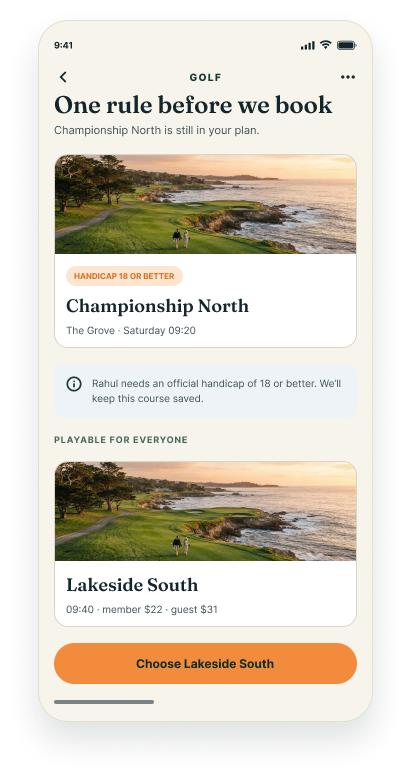
When Rahul’s beginner status blocks Championship North, the instinct is to hide the course or show a generic error. Instead, Golf keeps the course visible with the handicap requirement stated plainly, offers same-property alternatives with member and guest rates for each, and provides a reminder for when eligibility changes.
Four players can mean different rates, eligibility rules, carts, rentals—and a tee time that can disappear.
The deeper failure is uncertainty: late rules and fees, totals that do not add up, failed QR codes, and plans that cannot change without restarting.
What people optimize for isn’t the booking.
A synthesis framing the emotional and operational jobs behind a golf day.
People before places
The crew’s needs shape the plan before a course or package does.
Confidence before convenience
A fast flow is only valuable when rules, rates, and outcomes feel certain.
Routines over rediscovery
Saturday golfers want to repeat a trusted plan, not rebuild it every week.
Experiences over categories
People ask for a day together—not a tee time, cart, rental, and lesson separately.
Reliability is part of the experience
A failed hold, unclear total, or unreadable QR changes how the whole venue feels.
Design the truth into every state.
Explain every constraint
Rules arrive before the golfer reaches a dead end.
Keep intent alive
When one option closes, preserve the plan and redirect it.
Show the complete math
Rates, extras, credits, and holds reconcile in one place.
Design graceful recovery
Every fragile state has a legible, human fallback.
Eight moments where trust can hold—or disappear.
The product is organized around the moments a golfer, organizer, or clubhouse team needs the system to be unmistakably honest.
A “not yet” that doesn’t feel like a no
Rahul asks for Championship North. The concierge keeps the aspiration visible, explains the handicap rule, and finds a path the whole crew can play today.
The blocked course remains part of the story instead of disappearing behind an error.
Preserve intent · state the rule · offer a credible next move
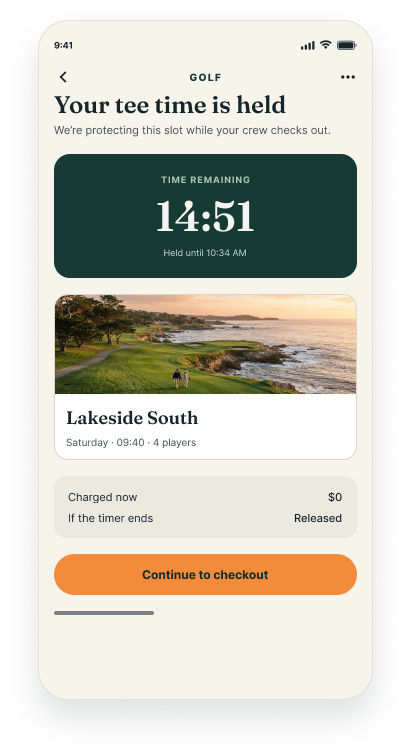
A held tee time you can trust
A live hold makes scarcity concrete: one tee time, one clear timer, and an explicit outcome if the group does not finish.
The system separates “selected” from “secured,” so urgency never becomes ambiguity.
14:51 remaining · reserved for your crew · no hidden charge
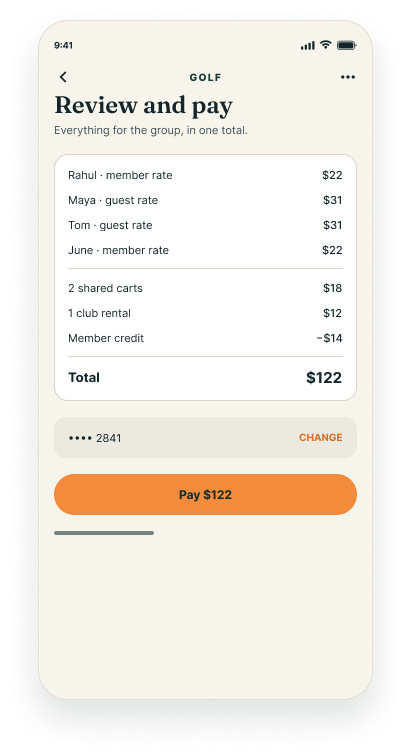
Everything accounted for before paying
Member and guest rates, carts, rentals, and taxes resolve into a total the organizer can explain without doing the math twice.
Every line item answers who it belongs to and why it is there.
4 players · 2 carts · 1 rental · member credit applied
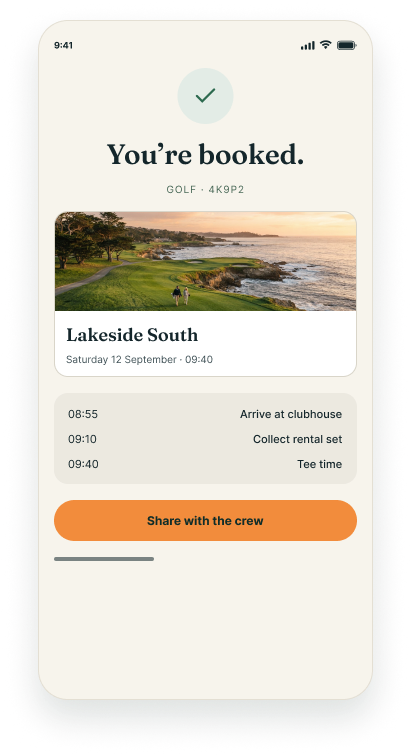
Confirmation that closes the loop
Payment is not the finish. The confirmation turns a transaction into a usable plan with time, location, group status, and next steps.
The organizer knows what is done—and what still needs attention.
Booked · shared with crew · ready for Saturday
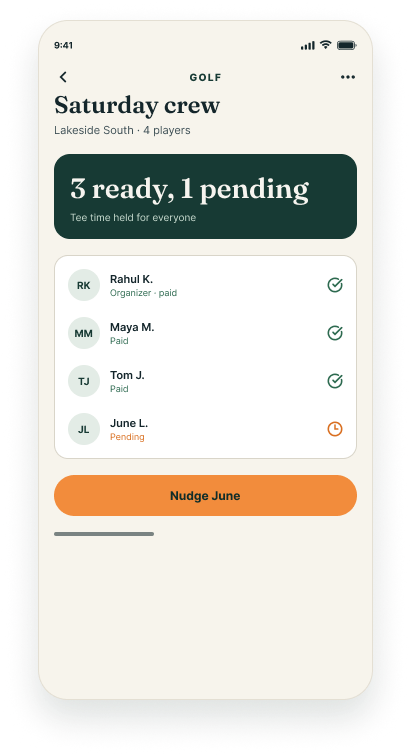
A group that coordinates itself
Invites, payment, rental needs, and arrival status live in one lightweight group view rather than a chain of screenshots and messages.
A useful overview replaces the organizer’s private checklist.
3 confirmed · 1 pending · organizer can nudge once
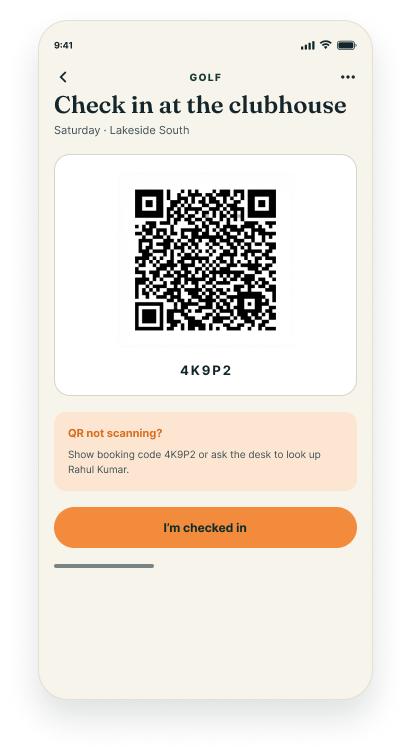
A check-in that works when the QR doesn’t
The primary QR is fast, but the booking code and clubhouse lookup remain visible enough to rescue a real arrival.
Recovery is designed into the happy path, not hidden in support.
QR · booking code · staffed check-in
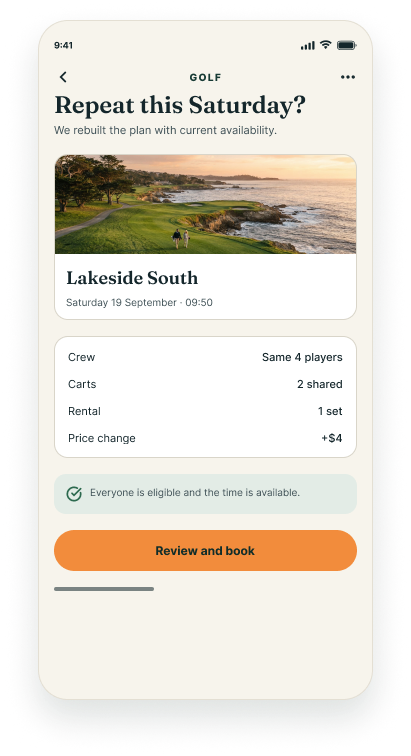
Repeat in one review
The crew can replay a trusted Saturday without reconstructing it from categories—then review the few things that changed.
Routine becomes a feature while control stays with the player.
Same course · same crew · one review
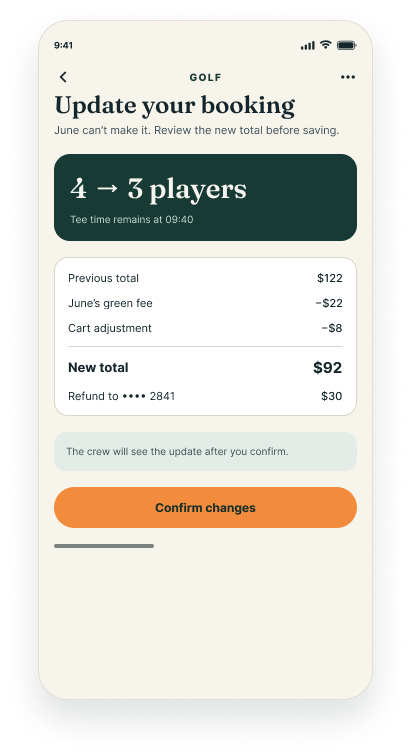
When plans change
Removing a player recalculates the booking in place and makes the refund, new split, and remaining total explicit before confirmation.
A changed plan should never force the organizer to start over.
4 → 3 players · credit $31 · new total $92
Prove that confidence survives the messy moments.
The next round would pair realistic booking tasks with interruptions: an ineligible player, an expiring hold, a failed QR, and a last-minute cancellation.
4 members · 3 first-time visitors · 3 group organizers · 2 clubhouse staff
Task confidence
Can participants explain what is held, paid, and pending?
Price comprehension
Can every participant reconcile the total without help?
Recovery success
Can a failed scan or changed player be resolved in place?
Repeat intent
Would the group confidently use this plan again next Saturday?
Trust comes from small honest states—held, expired, pending, refunded.
These moments matter more than adding features. They are where a concierge proves whether it understands the plan, the money, and the people involved.
I would bring venue staff in earlier because the clubhouse service handshake is part of the product—not an edge case after the interface is done.