


01
5 role-specific hubs
Custom-fit operational spaces for branch operations, treasury, Sharia compliance, and procurement managers.

I designed role-based workflows and information architecture for an enterprise banking platform spanning Sharia finance and multi-channel operations.

This project was completed under NDA for a confidential enterprise banking client. Names, data, & visuals shown here are recreated & representative, not the original product.
Custom-fit operational spaces for branch operations, treasury, Sharia compliance, and procurement managers.
Mapping multi-stage, weighted cycle-time flows into unified visual trackers.
Engineered for Arabic (RTL) and English (LTR), with native font optimization.
Accessible design tokens built for fast-paced, high-density transactional screens.
Enterprise banking teams across corporate operations, trade settlement, Sharia finance, and procurement relied on separate legacy systems. This created fragmented customer insight, duplicated workflows, disjointed system statuses, and heavy cognitive load whenever relationship managers had to switch operational context.
The platform needed to unify five distinct business dimensions into one navigation structure, while keeping each role's priorities distinct.
A single platform, five distinct decision-makers - each needing their own priorities surfaced first, without duplicating the underlying system.
Adapts to each user's operational role, surfacing contextual priorities first.
High-level KPIs shown instantly, with dense metadata behind interactive layers.
Uniform structural grids across portals to reduce cross-departmental load.
Designs prioritize decisions over static figures, using clear alert states.
RTL Arabic and LTR English built natively into the typography system, not retrofitted.
Paired a high-performance Latin numeral typeface (for precise vertical alignment of financial ledgers) with a native Arabic corporate typeface, so both languages read with equal clarity in tabular data.
Every dashboard was designed with full Arabic RTL support as a core requirement, not an afterthought. Navigation, data tables, KPI cards, and charts mirror seamlessly between LTR and RTL layouts.
Built for high-intensity, daylight operations, with a token system ensuring WCAG AA contrast across every component:
A full atomic library - typography scale, core palette, button system, data tables, status chips, and an 8-point spacing scale - built to support Sharia-compliant financial taxonomy across all five hubs.
Figures shown across these views are illustrative, built to represent realistic operational scale rather than actual client data.
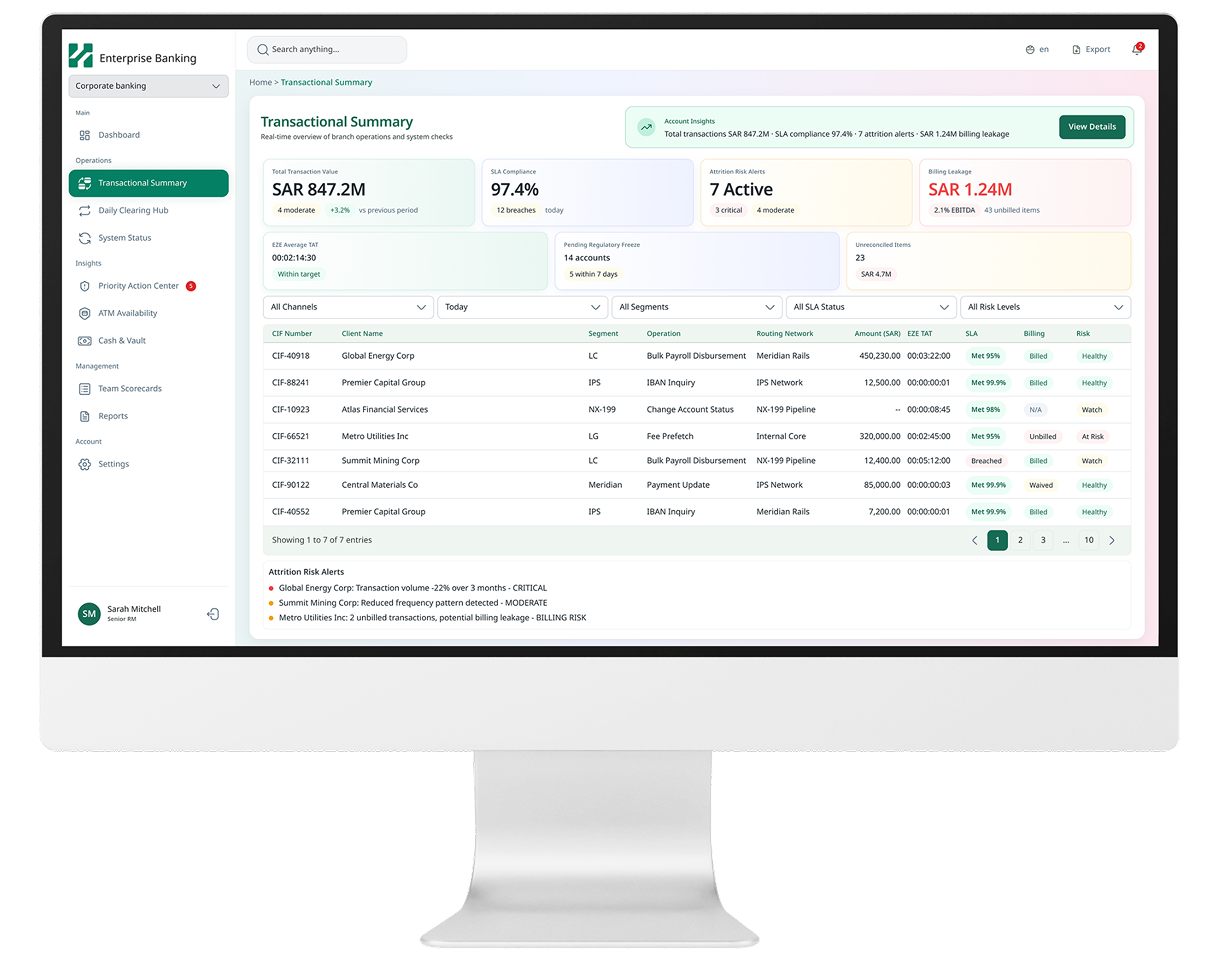
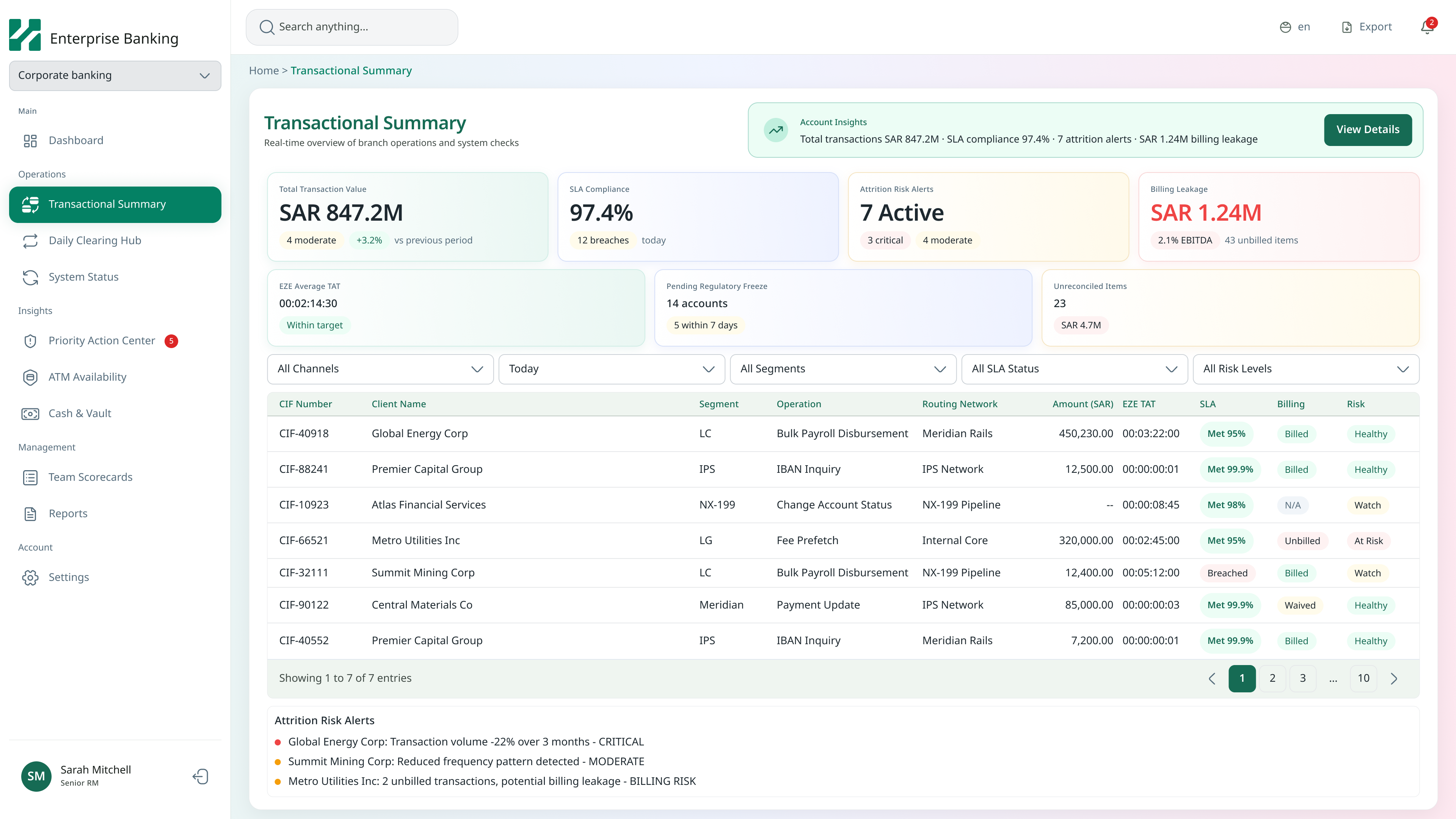
Transaction monitoring, status tracking, and retail banking operations for branch managers.
What this view supports: Real-time transaction visibility, SLA achievement tracking, critical risk alert escalation, and transaction records broken down by client tier and department.
Design highlights: Real-time KPI cards with color-coded status and trend lines; a prioritized risk alerts panel with severity classification and quick-action escalation; a high-density transaction table optimized for readability; live system status widget.
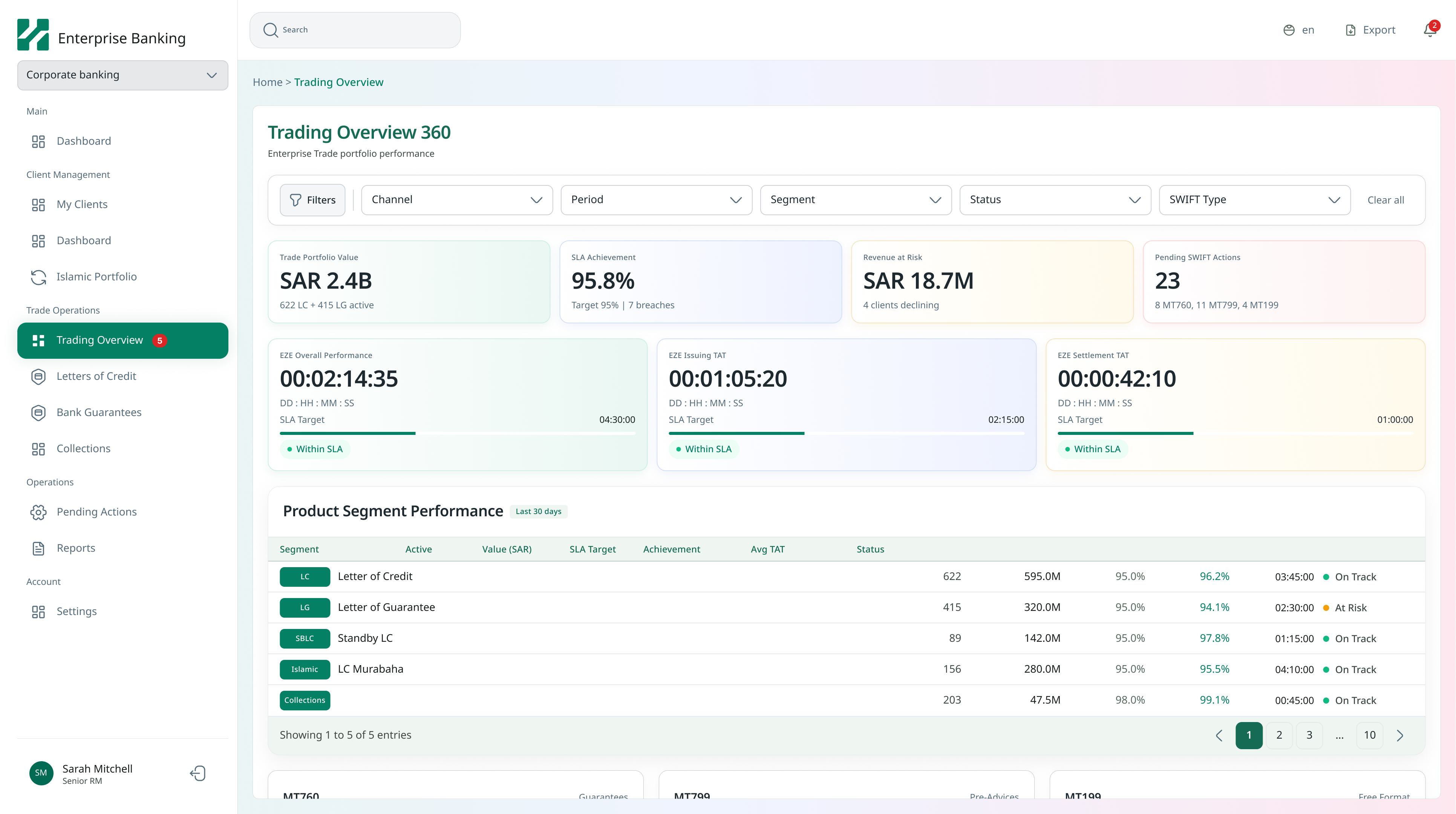
Trading pairs, real-time pricing, and derivatives overview for treasury analysts.
What this view supports: Portfolio value tracking across active deal segments, end-to-end performance timers, product segment SLA compliance, and MT message/documentary credit monitoring.
Design highlights: Performance timer cards with visual SLA status anchors; product segment matrices using Sharia-specific transactional states; interactive message-volume tracking; a global filter bar for rapid pivot analysis.
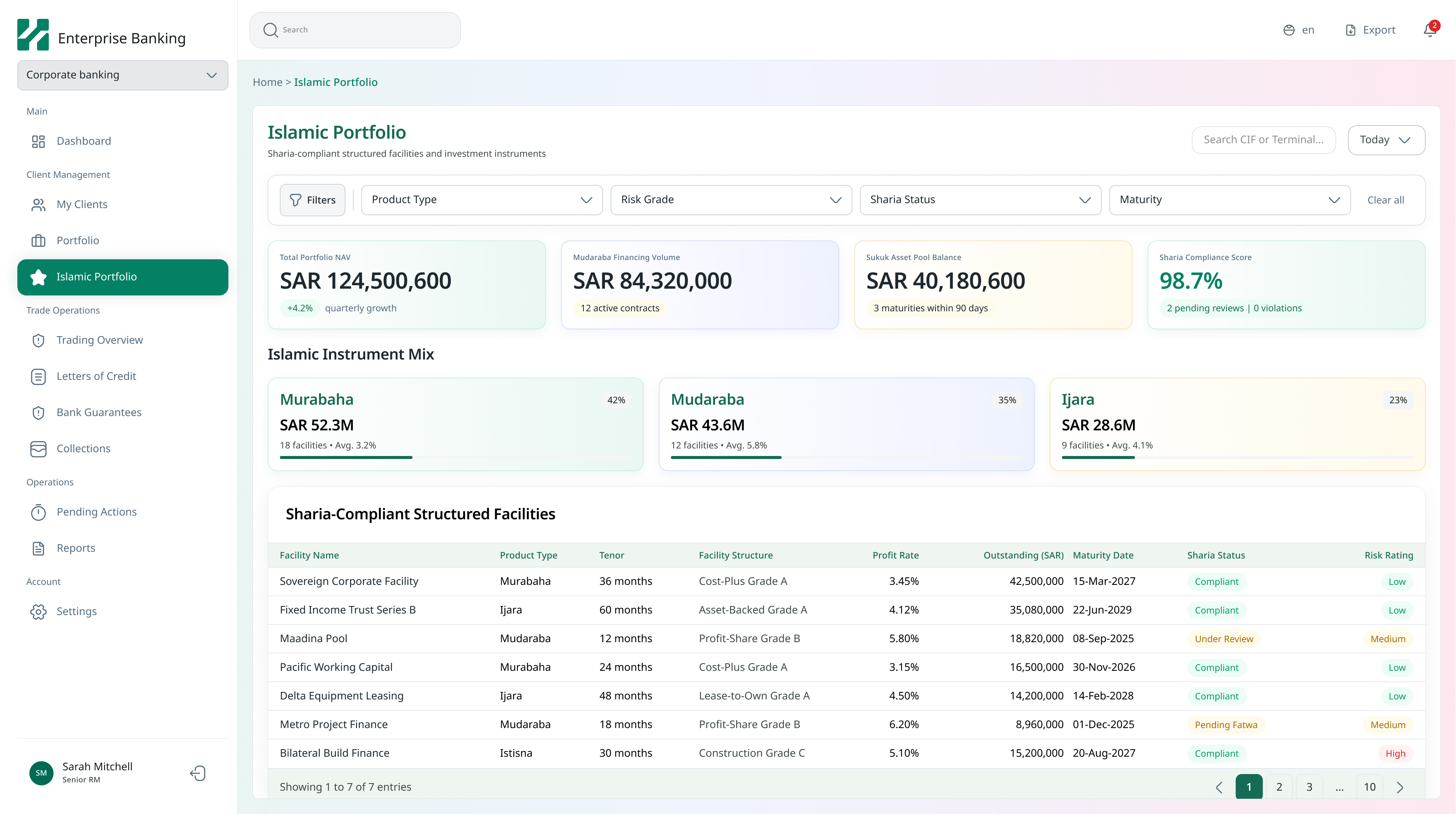
Portfolio compliance monitoring and Sharia-compliant investment tracking.
What this view supports: Portfolio-wide compliance scoring, instrument mix tracking (Murabaha, Mudaraba, Ijara), structured facility details with profit rates and risk ratings, and Sharia Board review timelines.
Design highlights: Instrument mix visualization cards; a structured facilities ledger; a centralized compliance monitor; a unified maturity timeline for portfolio planning.
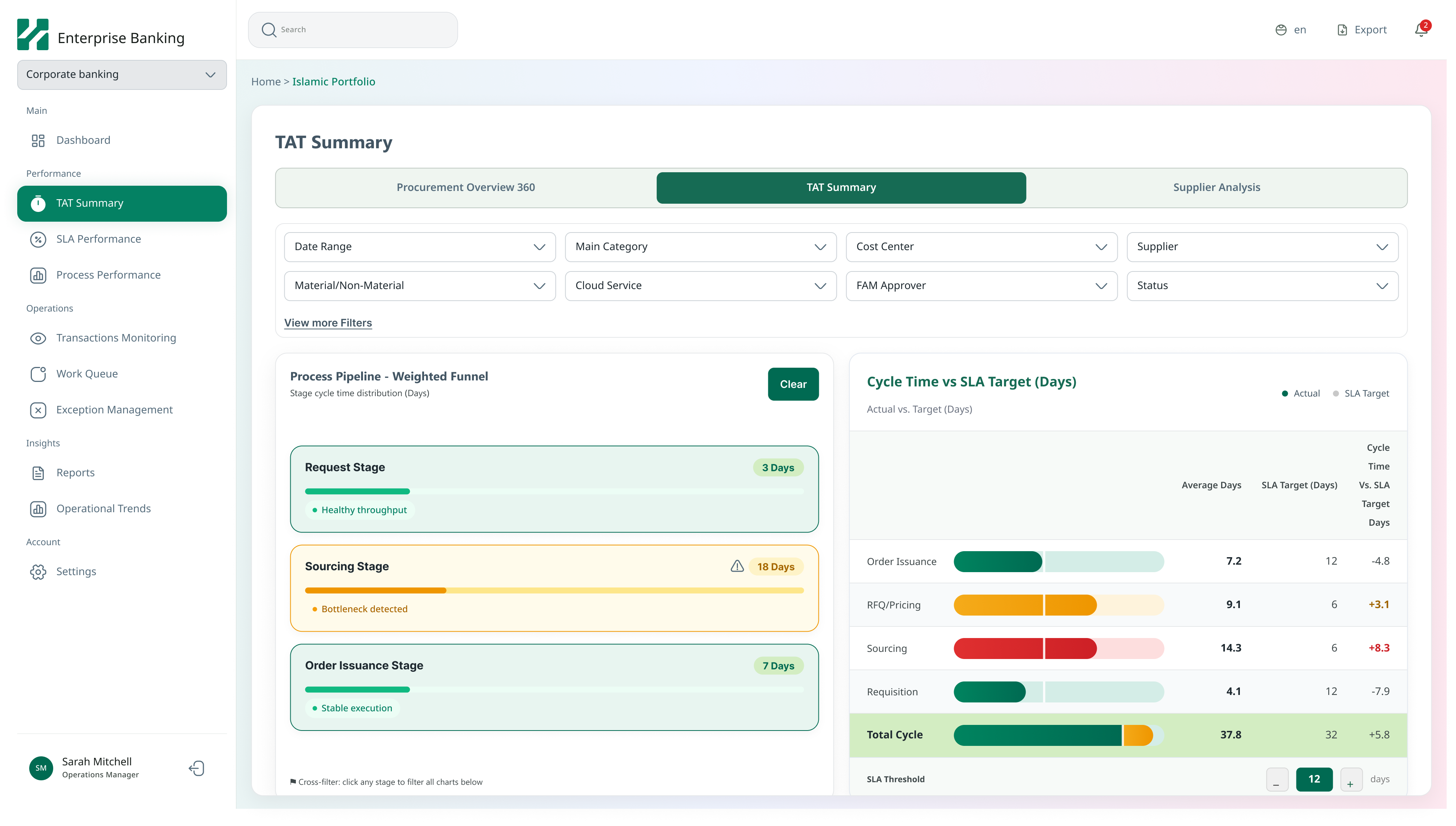
Turnaround-time analysis, SLA compliance, and alert prioritization for operations leads.
What this view supports: Real-time processing throughput, weighted stage-by-stage process metrics, SLA breach identification by segment, and trend analysis for capacity planning.
Design highlights: A process builder timeline with weighted stage tracking; a segment-level SLA pass/fail table; aging statistics with risk-threshold alerts; a rolling weekly trend chart.
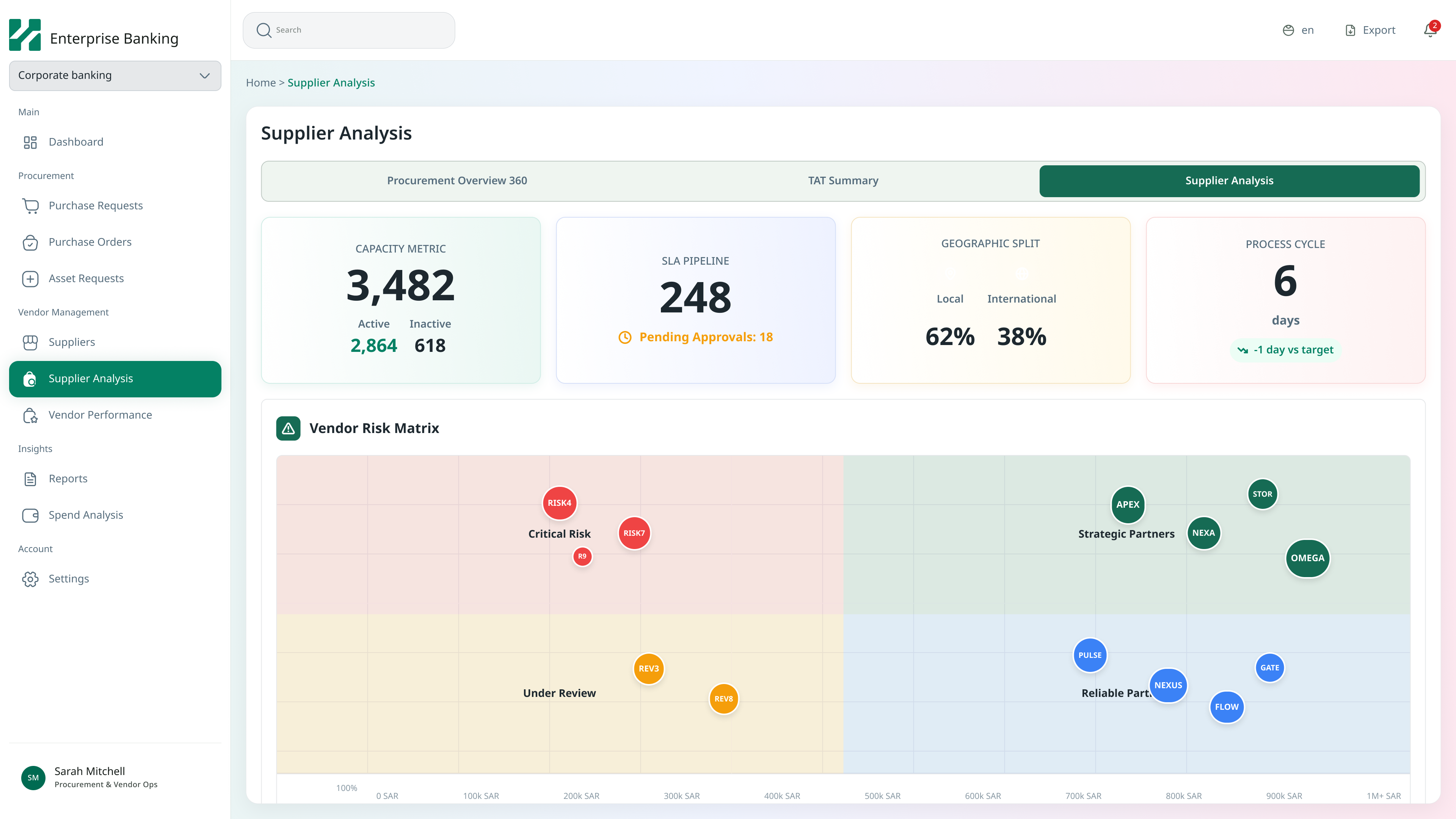
Vendor performance metrics, procurement analytics, and supply chain risk.
What this view supports: Supplier monitoring across billing platforms, payment network coverage, vendor SLA trends, and cost-optimization insight.
Design highlights: A vendor risk matrix plotting tier against risk factors; a payment network performance comparison; a correspondent bank performance ledger; revenue and volume analytics.
5 role-based hubs, unifying previously fragmented departmental systems
A shared component library and semantic token system used across all views
Full bilingual (English/Arabic RTL) coverage across every screen, table, and chart
Reduced the number of systems a relationship manager needs to check for a full operational picture, from several disconnected tools to one
Made role-specific priorities visible immediately, rather than requiring users to search for what is relevant to them
Built a consistent pattern language that should shorten onboarding time for new users moving between departments
Enterprise UX turned out to be less about creating visually distinct dashboards, and more about designing consistent systems that support different operational responsibilities while staying familiar across roles. The bilingual RTL requirement pushed my thinking on layout architecture further than I expected - every component had to work in both directions without losing usability.